Privacy-Enhancing Technologies: Enabling Data Innovation Without Compromise

Gregory Collet – Introduction
In many organizations, data innovation and privacy are still managed as mutually exhaustive. On one side, product and innovation teams push for AI, new digital services: partnership and data spaces. On the other, legal, compliance, and security functions are mandated to prevent harm and control risk. The dominant narrative follows: to innovate, organization must accept more privacy risk; to protect privacy, they must slow down innovation. The perception persists largely because of how data environments are structured. Data remains in silo by department, country and partner. Each new use case triggers new negotiations, new Data Protection Impact Assessment, … The result is friction at every step: friction to access data, to share data and to combine data across entities or jurisdictions. Privacy-Enhancing (Confidentiality) Technologies, or PETs, Federated Learning, secure multiparty computation, synthetic data and related technologies aim precisely at shifting this equation by allowing useful computation without exposing data directly. This is not science fiction. PETs are grounded in cryptography, privacy engineering and statistics. Regulators increasingly reference them to reduce risk and enable responsible reuse. “Without compromise” is an aspiration, not a guarantee. PETs do not eliminate trade-offs, they reshape them (privacy versus performance; cost versus scalability). The real question is whether PETs can provide a better option with measurable properties so innovation, legal, engineering team can make informed decisions together.
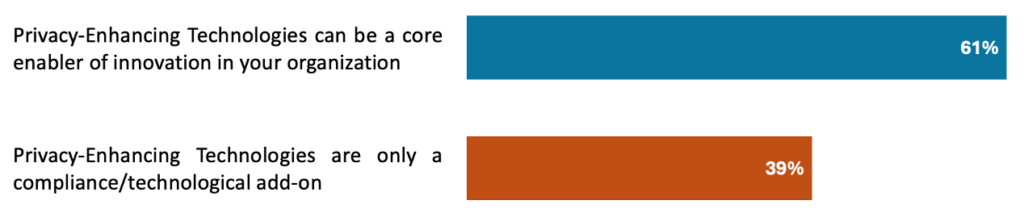
To evaluate the audience’s initial mindset, we invited them to complete a poll following the introduction with the questions: “”Do you believe Privacy-Enhancing Technologies can be a core enabler of innovation in your organization or it is just a compliance/technological add-on?”. The results are shown below:
Aymeric Pontvianne: From an innovation perspective: can privacy/compliance be considered an enabler?
Regulation imposes strict limits on how data can be used, which creates a need to innovate to meet both compliance requirements and computational needs. PETs arise precisely from this tension: they enable new methods that respect legal constraints while still allowing meaningful data processing. In this way, regulatory pressure becomes a driver for innovation.
Sophie Stalla-Bourdillon: Do PETs change the legal qualification of the data itself, or only the way we consider the data in a specific context?
To determine whether PETs change the legal status of data, we need to examine the specific method used and its effect on identifiability. The answer also depends on the release context: has the data been pseudonymized or transformed into synthetic/aggregated outputs? What technical and organisational controls exist (key separation, access control, audit logs, contractual limits, onward-transfer restrictions) that could prevent re-identification? This brings us back to examples such as the SRB case, where the analysis turns on “in whose hands” the data sits and what means are realistically available. For the moment, we navigate case by case there are no harmonised European operational guidelines on PETs and identifiability thresholds. The UK ICO frames PETs as data minimization techniques, but EU policy shifts (e.g., Omnibus package) could recalibrate expectations and enforcement practice.
Maarten Everts: What is the biggest misconception about PETs?
There are two extremes. Some people believe PETs are a kind of magic that allows us to escape the GDPR, which is wrong. Others think PETs are an illusion and simply do not work, which is equally false. PETs that combine homomorphic encryption, which allows calculations to be performed on encrypted data, with Secure Multi Party Computation, which decentralises computation among several actors without revealing their inputs, exist and function in practice. The real point is that PETs do not remove obligations; they change the technical conditions under which processing occurs and can reduce exposure when designed properly. A major limitation of many PETs is that they split data into several locations. Once this happens, it becomes very difficult to naively explore the data, because no one can see the entire dataset at once. To some extent, this forces a shift from exploratory to “query-by-design”: you must define the objective and features upfront. In such situations, the data can only be used to answer specific predefined questions. That is why governance, orchestration and outputs controls are as critical as cryptography.
Aymeric Pontvianne: How do PETs enable new market models?
We can have three different dimensions. First, PETs do not fit traditional business approaches built on exclusive data ownership and bilateral sharing. They encourage data contribution in a model closer to open-source logic, where value is created through trusted participation and shared outcomes rather than raw dataset transfers. Second, by allowing safer collaboration around sensitive data, PETs can stimulate competition and lower barriers, making it easier for new actors to enter to the market. Third, PETs support interoperability within the ecosystem: they can connect data sources, but true interoperability requires common standards and governance, as foreseen in the European Health Data Space. Adoption therefore depends on aligned technical interfaces, assurance mechanisms (auditability, measurable privacy) and clear accountability rules. Today, PETs development remains below its potential and demand remains limited. But uptake is likely to grow as regulatory pressure and ecosystem initiatives increase.
Emmanuel Pham: When do synthetic data enable innovation, and when do they distort reality?
Synthetic data should not be framed as “never distort reality”, (what is reality?) but as producing a model-based approximation of reality: they reflex the assumptions, constraints and sampling properties of the source data and generator. They offer an alternative perspective on real data. The question becomes how accurately do they represent the world? Enable innovation when they provide safe, scalable access for exploration, testing and sharing (e.g. simulating cohorts that are not yet available, adapt synthetic datasets to specific needs, increasing sample size for rare diseases). Synthetic data must therefore be validated against real dataset using utility metrics (distributional similarity, predictive performance, coverage of edge cases) and privacy metrics (attribute inference, linkage risk). When used correctly, synthetic data can even help identify biases or missing values in real dataset acting as a diagnostic tool rather than a substitute for ground truth.
Sophie Stalla-Bourdillon: Where do PETs reduce or remove risk?
Zero risk is an illusion. PETs do not eliminate risk but reallocate and attenuate it across the data life cycle. They reduce risk most effectively when the dominant threat is unauthorised disclosure of sensitive attributes (e.g. during data sharing, cross-border collaboration). Hard PETs, such as differential privacy or homomorphic encryption can provide formal, mathematically specified guarantees under explicit threat models: differential privacy bound the incremental disclosure attributable to any individual, while homomorphic encryption enables computation over ciphertexts without revealing plaintext to the compute operator. However, guarantees are conditional on correct parameters, implementation and governance.
Rafa Gálvez Vizcaíno: What is the state of research on PETs?
Applied research increasingly evaluates PETs in concrete deployments, but results are often context-dependant and non-transferable: assumption about data distributions, operational constrains vary across domain, so conclusions from one setting do not necessarily generalise to another. A key scientific challenge is composition: we cannot reliably predict how PETs interact when combined, nor how the parameterisation of one PET propagates to overall utility, privacy and robustness. This creates a need for standardised benchmarks, interoperable threat models, and reproducible evaluation protocols that jointly measure privacy leakage, utility degradation and attack resilience. A second difficulty is on the regulatory side: authorities want guarantee about PETs efficacy while PETs are conditional on explicit models and correct implementation and so subject to uncertainty. Bridging this gap requires evidence and formal proof.
QA
What is the common definition of PETs?
The term “Privacy Enhancing Technologies” is used very broad, and in practice this can be misleading: a single definition is rarely operationally useful. A more functional approach is to define PETs as techniques that measurably reduce privacy risk or exposure for a specific use case and threat model, while preserving a target level of utility. This highlights the context dependence of PET claims: different PETs protection against different risks (disclosure, linkage, inference, misuse) and their effectiveness depends on architecture and governance. Federated learning illustrates this ambiguity. It is often classified as a PET, yet its primary purpose is collaborative model training, not privacy per se. Depending on the design, Federated learning can introduce risks such as interception during transfer between the different parties. Without secure aggregation, encryption in transit and outputs controls, “federated” can still be leaky.
In cases where synthetic data are misused, who is responsible?
Responsibility depends on the role of each actor. The person who generates the synthetic dataset is responsible for the quality of the dataset (including documented fit-for-purpose, validation metrics, limitations), just as a car manufacturer is responsible for the quality of the cars it sells. However, if someone misuses the dataset, the responsibility shifts to the user, especially where use exceeds the stated scope or ignores safeguards, just as a reckless driver is responsible for their own accident.
How can one verify that a PET is effective? Can PETs be certified by authorities?
When an authority certifies a PET, it validates the specific claims made by the developer. For example, if the developer claims that the residual risk is five percent and this is demonstrated empirically, the authority certifies the technology at that five percent level. However, a certified method does not imply that every implementation is safe: configuration, key handling and deployment context can undermine guarantees. Authorities cannot verify each implementation in every system. The context evolves: new attack methods appear and sharing environments change. As a result, PET behaviour and strength can shift over time, requiring continuous monitoring, making certification difficult to achieve.
Currently, PETs are not mandatory in healthcare. How can organisations be encouraged to adopt them?
One approach is to emphasise their financial advantages or their value for research, notably reduced transaction costs, faster data access approvals and easier collaboration. Whether or not a method is formally labelled as a PET is not what matters. What matters is its effectiveness and evidence supporting it. If a technique can reduce risk, save money, or accelerate scientific discovery while providing measurable assurance and auditability, it becomes attractive for adoption.
Implementing these techniques adds complexity because it combines technical knowledge with regulatory knowledge. How can this be handled?
In many cases PETs increase complexity, but not always. In specific architectures, they can even simplify legal considerations. For instance, federated analytics or secure enclaves keep personal data in situ, reducing exposure and often materially limiting cross-border transfers cross organisational exchanges.