
[October 27, 2026]
From Compliance to Trust: Privacy as a Competitive Advantage

Session recap, Data Privacy for Health Summit, Boston, 1 October 2026
Moderator: Kaouthar Lbiati, MD, former Biopharma CEO, Independent Board Director and Senior Advisor.
Panelists: Daphna Patishi-Pryluk, Global Ethics & Compliance Leader | Healthcare Industry; KimberLee Heidmann, Senior Vice President, Compliance, DPO, Scout; Jessica A. Vozella, Esq., Executive Director, Head of Contracts and Corporate Counsel, Dyne Therapeutics; Ron Zalkind, Founding General Partner, Lama Partners.
Privacy is often treated as a cost of doing business. The penultimate panel of the Data Privacy for Health Summit in Boston asked the opposite question: when does data governance create value? Kaouthar Lbiati, a biotech executive who sits on the board of a clinical-stage oncology company and advises senior executives at Roland Berger, opened by presenting a report she co-authored this summer with two Roland Berger partners, Health Data Governance: From Compliance to Enterprise Value, available on the Roland Berger website. The report explores a fundamental shift that is taking place: Health data governance is no longer simply a question of compliance and risk management. Increasingly, it is becoming a question of trust, competitiveness, innovation and value creation, and that is because health data sits at the intersection of some of the most consequential forces transforming healthcare today: Artificial intelligence, scientific innovation, data sovereignty, privacy, regulation, cybersecurity and digital identity.
What changes when governance becomes strategic
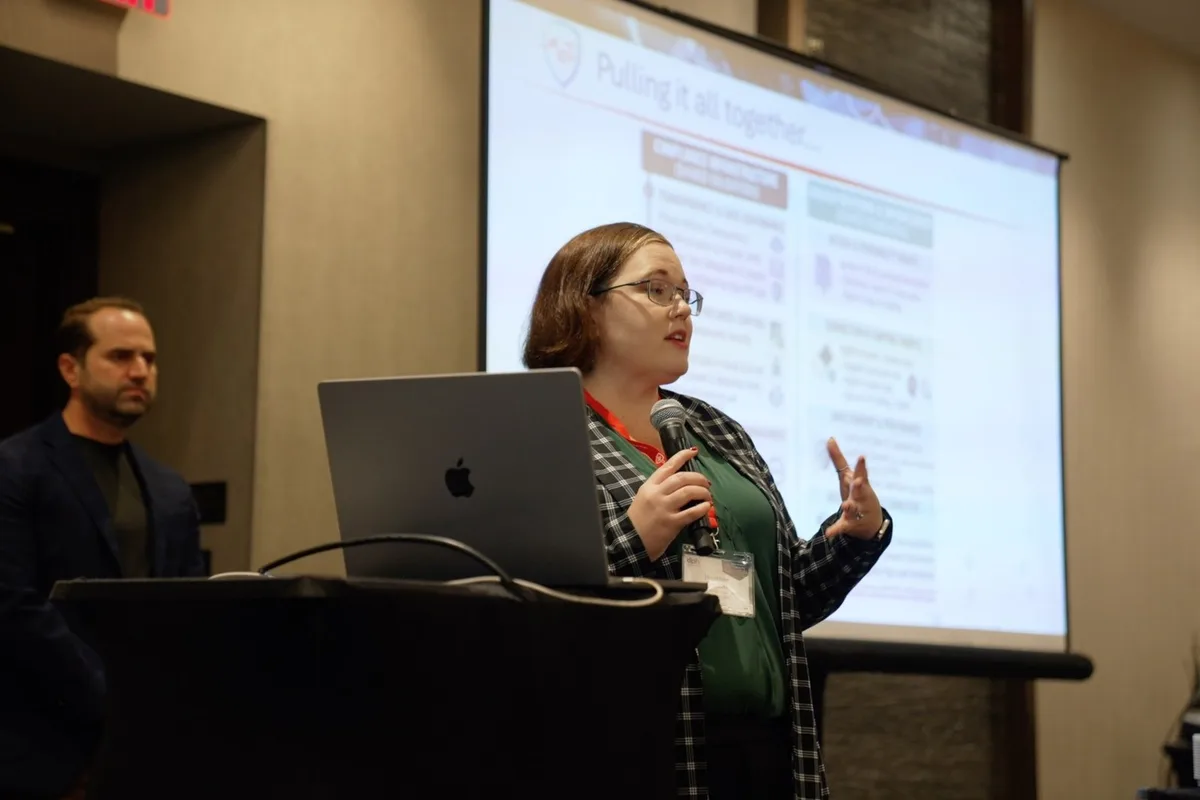
The report, and the slide shown behind the panel, listed the mechanisms through which governance creates value: faster clinical development, access to data, strategic partnerships, patient trust, lower operational risk and better strategic decisions.
Kaouthar asked each panelist what changes they had observed when companies treated data governance as a strategic capability instead of merely a regulatory obligation.
Ron Zalkind, who invests in early-stage cybersecurity and AI companies after founding data security businesses, including one acquired by Cisco, where Ron went on to run cloud security, sees data becoming a true asset as companies build intelligence into their products. Some companies train their own models; others build training environments they sell to frontier AI labs. Ron noted that governance may receive less attention in the earliest stages of a business, yet it is becoming increasingly relevant in merger and acquisition discussions.
Daphna Patishi-Pryluk, a lawyer certified in Israel and the UK who led legal teams at AstraZeneca Israel and Medtronic Israel, described the rare disease context. When the patient population is small, the data that can be collected is limited by nature, which makes it highly strategic and calls for the right guardrails so it can be leveraged properly, and reused over time.
KimberLee Heidmann, who heads compliance at Scout, a third-party provider that organizes travel and logistics for clinical trial participants worldwide, pointed to trust on two fronts, drawing on an organization whose compliance program has matured considerably over the past ten years. Governance has a commercial impact. Yet, without patients’ trust, there would be no participants and no data to govern. And as a service provider, trust from Scout’s industry clients is equally paramount - If sponsors do not trust how a vendor handles their data, they will simply not select it in the first place let alone do business with it repeatedly over time.
Jessica Vozella, who heads the contracts department at Dyne Therapeutics after some thirty years in biotech and earlier work in software licensing, personal injury law and criminal defense, explained that Dyne has spent four years building a data protection framework with MyData-TRUST. On the cusp of a product launch, the company is seeing the result: owning its data and what it does with it gives it confidence, and that same confidence helps attract investment and clinical sites around the world.
The investor lens: can you prove your rights to the data?

Panelists discussing the investor view on health data governance, Boston 2026
Ron compared the situation with the security sector. Fifteen years ago, chief information security officers were rarely seen as top executives; today they serve on Boards and advise Board Directors. Ron expects the same to occur to privacy and data governance professionals over the next decade, as data becomes central to enterprise value.
Kaouthar revisited the point made by Ron earlier and directly asked how much the quality of data Governance affects M&A transactions’ attractiveness. Ron noted that governance frameworks are evolving rapidly – those frameworks from three years ago already look outdated and that whatever is said today may be irrelevant in six months. Ron mentioned a well-known precision medicine company that licenses de-identified oncology data to a large pharmaceutical group for AI model training, while facing separate lawsuits over a different set of genetic data. The root question in both cases is whether the company can prove it has acquired the rights to use the data the way it does.
Increasingly, Ron said, the value of an acquisition target lies in proprietary data or in a proven ability to train models for specialized domains. That depends on the quality of the data, pipeline, and the way models are trained and benchmarked. Ron cautioned against putting a precise percentage on the link between governance maturity and deal value. His central point was that clearly demonstrable rights to use data are essential to the value and viability of an AI model. This item was not part of the due diligence process six months earlier.
When asked in a follow-up question by Kaouthar where do today’s governance AI technology models fall short, Ron argued that in the field of technology, designing governance policies as a checklist of permissible tasks, no longer work with AI agents that can reason and go off-track. Checking identity, permissions, or tool access is not enough when an agent does something unexpected at run time. Emerging solutions build intelligence into oversight itself, almost as a super-agent supervising other agents.
Climbing the governance maturity ladder
Kaouthar asked KimberLee to walk through the governance maturity ladder, from basic compliance to value creation. KimberLee described the journey of a relatively young organization moving from basic compliance towards a more strategic value-creating approach. What had to change were both the culture and the infrastructure. The hardest part was literacy: constantly educating colleagues enabling the organization to effectively climb the governance ladder. Borrowing an earlier speaker’s reference to Steve Jobs, KimberLee suggested starting from the end goal: once the organization knows what it wants to achieve through its data and the purpose of doing so, it can work backwards towards the objective.
One framework, or many?
Kaouthar highlighted that health data are becoming a national security asset and an instrument of industrial policy, and long-term bargaining power in the race for the global AI leadership. She added that current global governance frameworks were fragmented and for organizations operating across several jurisdictions, this can be uncomfortable to navigate. Kaouthar then asked whether a single global governance framework is realistic.
Jessica would have preferred a one-and-done framework. To design its governance framework, Dyne used the existing EU data protection as a starting model. As it expanded its trials worldwide, it noted variability in the requirements across jurisdictions and adapted to these on a case-by-case basis. Typically, Dyne uses a global data processing agreement and set of clauses built on GDPR requirements, with additional obligations, built in, when operating in Turkey or Japan for instance. It also uses consistent language across contracts and consent forms.
KimberLee takes a similar, conservative approach. Scout manages to the GDPR globally, but research adds layers on top: clinical trial regulations, the expectations of IRBs and ethics committees, and the review of consent documents. Building to the broader rules first is better, KimberLee argued: it is easier to scale back than to make a small framework more robust later.

Daphna Patishi-Pryluk (right), with Jessica A. Vozella and KimberLee Heidmann, Boston 2026
Rare diseases: keep the data at the source
Daphna approached the question differently. Before choosing a framework, ask what is really needed: what is the scope, what did patients consent to, does the data really need to be shared, and is there a less intrusive way to reach the same goal? A company operating globally does not mean data has to travel. “Federated approaches” keep data at the source, respect local requirements and let the statistical question travel from institution to institution instead.
Daphna believes the approach applies broadly but is especially strong for rare diseases, where very small populations are scattered around the world, and collaboration across scarce datasets is essential. Because the data is so valuable, compliance by design and privacy by design are, in Daphna’s words, a way of doing business. In Daphna’s view, patients with rare diseases are more than data subjects. They are partners whose feedback shapes the understanding of the disease and the design of solutions. For instance, patients’ individual insights and preferences are taken into account when designing clinical trials.
Kaouthar raised another issue; identifiability: Because of their small sample widespread across geographies, most patients with rare disease can be identified. Daphna emphasized that it is one of the greatest challenges in the field of rare diseases. Diagnosis, age, location, and genetics can easily point back to a person. The safeguards listed include pseudonymization, suppression of very small groups, continuous risk assessment, reinforcement of security tools in research environments with named users, grant of limited permissions and use of audit trails instead of datasets circulation, and federated analysis.
Trust and verification
When asked how trust can become a competitive advantage, Ron replied that he invests primarily in people and early-stage companies. He also pointed to a contradiction: companies work hard to make patient data safe while many patients upload their own health data into consumer chatbots. The difficulty, in Ron’s view, is to set up governance policies that are sound and do not change every month, while building an implementation framework that keeps up with the rapid evolution of technology. Trust is paramount and so easy to lose. Ron shared his perspective of where things are headed: frontier AI labs inviting regulators into their processes, “trust but verify”. That algorithmic verification will not be a manual audit; it will be very technical and continuous. Ron drew a parallel with FedRAMP, the US standard for cloud providers, whose continuous monitoring became increasingly automated. Asked by Kaouthar whether that verification should come from technology companies or from regulators such as METR, Ron answered that regulators are not leading indicators. Commercial providers, in Ron’s view, will build continuous trust first, with regulators and auditors gaining a glimpse into it, likely scaling through third parties.
Daphna said trust and good governance foster collaboration, willingness to take part in trials and willingness to share perspectives, and that the relationship with patients continues well after consent. KimberLee summarized it with “nothing about us without us” and “patients as partners”: impact, good data and good health outcomes are byproducts of doing the right thing. Jessica added that trust is how a company stays out of trouble, builds confidence in the data it files and secures the investment needed to bring a product over the finish line.
Where trust becomes enterprise value
Jessica closed with a formula: “Privacy protects trust, governance operationalizes trust, trust expands responsible access to data, and responsible access to high-quality data creates enterprise value”. Kaouthar added that none of this works at scale without trust. Across the panel, the examples pointed the same way: investors check data rights, sponsors choose vendors they trust, and patients, especially in rare diseases, take part when they believe their data is handled well.
Join privacy and compliance leaders at the Data Privacy for Health Summit in Brussels on 26 January 2027. Explore the agenda and register. The Summit will then head to San Diego for its next US edition in September 2027.
To learn more about the role of the DPO in clinical trials, visit our DPO as a Service page or contact us at [email protected].
FAQ
How can Data Privacy become a competitive advantage for Life Sciences organizations?
Strong Data Privacy governance can build patient and client trust, strengthen partnerships, attract investment, and support responsible data use.
Why does data governance matter to investors and acquisitions?
Investors increasingly consider whether organizations can demonstrate clear rights to use their data and maintain reliable governance frameworks.
How can organizations move from basic compliance to strategic data governance?
By improving data literacy, building appropriate infrastructure, and aligning governance practices with their long-term business objectives.
Related Posts
[ October 29, 2026 ]
The US Privacy Framework, from Clinical Research to Commercial