
[November 12, 2026]
AI Governance and Privacy: Your Questions Answered

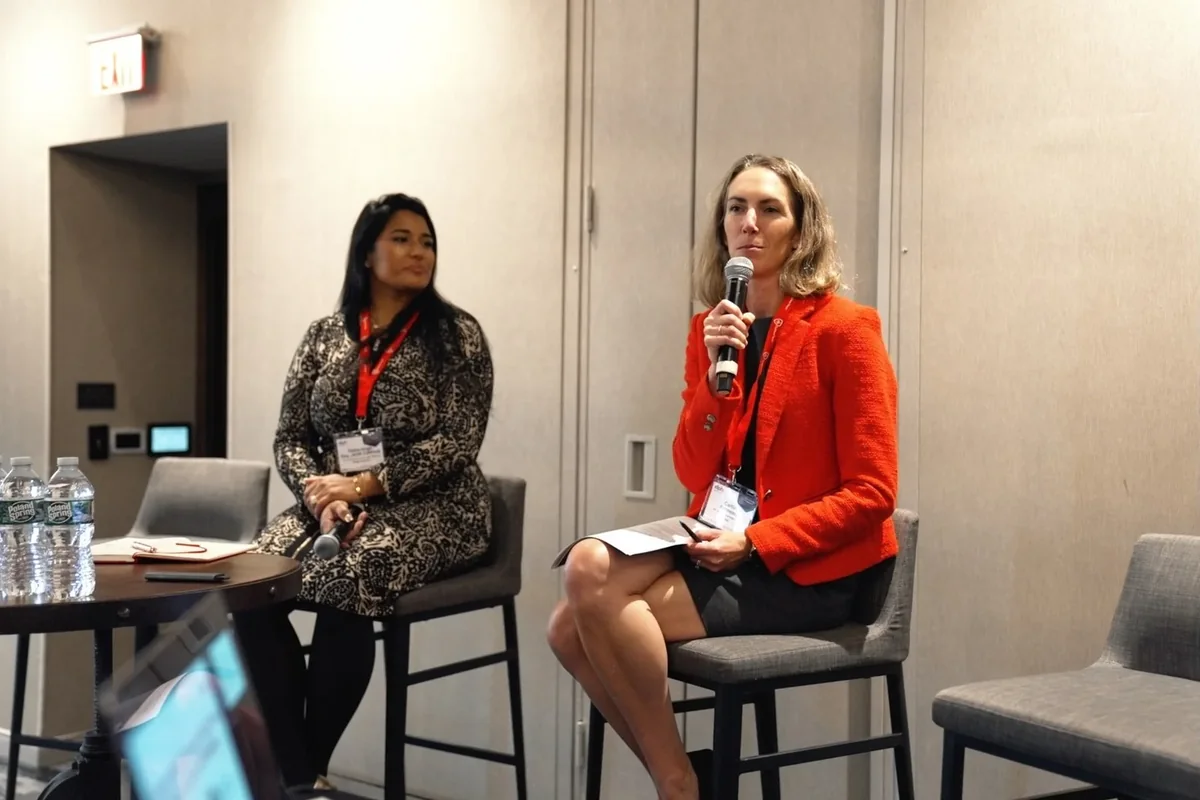
Session recap, Data Privacy for Health Summit, Boston, 1 October 2026
Moderator: ShanShan Pa, Global Head of AI and Data Governance, GlobalLogic.
Panelists: Maitreya Shah, Technology Policy Director, American Association of People with Disabilities (AAPD); Jordan Collins, General Manager, Privacy Analytics; Nicholas Accomando, Global Head, AI and Data Privacy Legal, Novartis; Eden Brownell, Founder, EmpathAIze Labs.
An interactive workshop after the morning presentations gave participants the opportunity to put real-world questions to a cross-disciplinary panel. Moderated by ShanShan Pa, the conversation ranged from disability inclusion and sensitive data inference to synthetic data, clinical research and practical AI approval processes. Across the topics, a consistent theme emerged: the right safeguards depend on how data and AI are actually used, and on who may be affected.
Sensitive inferences and inclusive design
Maitreya Shah described how AI systems may infer disability from signals that do not look like health information at first glance, including accessibility-related behaviors and other digital traces. Such inferences can create opportunities for useful services, but they can also expose people to exclusion or unwanted profiling, including in contexts beyond HIPAA’s coverage.
The discussion highlighted a tension: information shared to make a service accessible can also be used in ways that disadvantage the person sharing it. ShanShan summarized the concern that data provided by individuals can be used to identify them and restrict their opportunities. Maitreya and other panelists emphasized involving affected communities early in decisions about data use and system design, consistent with the principle “Nothing about us without us.”
Synthetic data and anonymization: useful, not universal
Questions about synthetic and anonymized datasets brought the discussion to both privacy protection and representation. Maitreya cautioned that synthetic health records can reproduce biases embedded in their source material, particularly where clinical documentation misses the social context of disability. Small or distinctive populations may also be easier to single out even when direct identifiers are removed.
Jordan Collins stressed that neither anonymization nor synthetic generation is a universal solution. In rare-disease research, removing too much detail may undermine scientific utility. Appropriate safeguards may instead include restricted access, controlled environments, retention limits and clear research purposes. Nicholas Accomando noted that coded clinical-trial records do not automatically become anonymous merely because names are replaced with subject identifiers.
The panel also discussed tokenization, which can help link records across datasets for research. Its value comes with a need toreassess linkage and re-identification risks as additional data sources are introduced. The overarching question is not simply whether a dataset has been transformed, but whether the intended use and surrounding controls are appropriate.
A practical front door for AI use cases
Audience questions then turned to operational governance: how should organizations review chatbots, productivity tools and systems used in regulated work? Nicholas described an AI “front door” approach at Novartis, in which use cases are registered and routed according to their characteristics and risk. The EU AI Act provides one reference point, alongside sector-specific and organizational requirements.
The lesson was proportionality rather than a single approval process for every application. Lower-risk uses can follow streamlined routes with clear boundaries, while applications involving regulated clinical or GxP activities require more detailed assessment and validation. Even a streamlined route needs users to understand what has been authorized and when a change in purpose requires renewed review.
The group also distinguished meaningful oversight from checking every output. Depending on the use case, appropriate oversight may involve intervention points, monitoring, audits, escalation paths and controls on how the system is used. Training and clear instructions help make those arrangements workable.
Research innovation depends on data quality and context
The workshop explored how research teams balance data access with privacy and scientific value. Participants discussed real-time sharing of aggregated trial information, the use of additional datasets to improve representation and the role of on-premises models in protecting proprietary information.
Jordan emphasized that data quality is not only a technical matter: provenance and fitness for the research purpose matter as well. Nicholas described how language models can help extract useful information from unstructured clinical notes and pathology reports, expanding the scale of possible analysis. Maitreya noted that adding external data can also introduce noise or bias, requiring careful evaluation of its effects.
ShanShan brought the conversation back to a foundational challenge: selecting a model may be easier than understanding the data landscape underneath it. Fragmented legacy systems, retention obligations, records management and operating costs all shape whether an AI solution can be deployed responsibly. The morning session’s principle, purpose before tools, applied just as strongly to research infrastructure.
Intellectual property and the data a model retains
The audience also raised intellectual-property and information-handling questions. Nicholas discussed how contractual terms and legal treatment of AI-generated outputs can vary by service and jurisdiction. ShanShan added that organizations should look beyond what they send into a model and what it produces: they also need to understand what the service retains or remembers, for how long, and under what deletion arrangements.
Where AI can help privacy teams
To ensure the conversation addressed opportunities as well as risks, ShanShan invited examples of how AI can support privacy and compliance work. Panelists and participants pointed to faster literature and document review, identifying protected health information or confidential content before publication, comparing agreements and preparing templates.
A participant also offered a data-minimization example: if a service only needs to establish whether someone is over 21, it should return that answer rather than disclose an entire identity. Thoughtful system design can both improve usefulness and reduce unnecessary exposure.
From questions to practical action
The workshop did not yield a universal checklist, nor did it need to. It demonstrated how practical governance combines data protections, fit-for-purpose validation, clear accountability, proportionate review and participation by affected people. These elements help organizations evaluate trade-offs rather than treat innovation and protection as competing goals.
The most useful question for any AI initiative may be the one the day repeatedly returned to: what is the intended purpose, and what evidence and safeguards will make that use appropriate over time?
Bring your questions to the Data Privacy for Health Summit in Brussels on 26 January 2027. See the programme and register. The Summit will then head to San Diego for its next US edition in September 2027.
For support with AI-related data protection, privacy compliance and oversight, explore our DPO as a Service offering or contact us at [email protected].
FAQ
Can synthetic data and anonymization fully eliminate Data Privacy risks?
No. Re-identification risks, potential biases, and loss of scientific value may remain, requiring additional safeguards. Working with experienced Data Privacy experts can help organizations anticipate these challenges, implement appropriate safeguards, and respond effectively when issues arise.
How can organizations assess and approve AI use cases effectively?
By implementing a risk-based approval process with proportionate assessments, clear boundaries, and appropriate oversight. Having the right expertise and guidance throughout this process helps organizations make informed decisions, avoid unnecessary compliance risks, and move forward with confidence.
How can AI support privacy and compliance teams?
By accelerating document reviews, detecting sensitive information, comparing agreements, and preparing templates. When combined with human expertise and proper oversight, AI can help privacy teams work more efficiently, allowing professionals to focus on higher-value tasks, strategic decisions, and complex compliance challenges.
Related Posts
[ November 10, 2026 ]
The Augmented DPO: Where AI Stops, Human Judgment Begins
[ November 13, 2026 ]
Consumer Health Data Laws, Litigation and the Post-HIPAA Reality