
[November 10, 2026]
The Augmented DPO: Where AI Stops, Human Judgment Begins
Session recap, Data Privacy for Health Summit, Boston, 1 October 2026
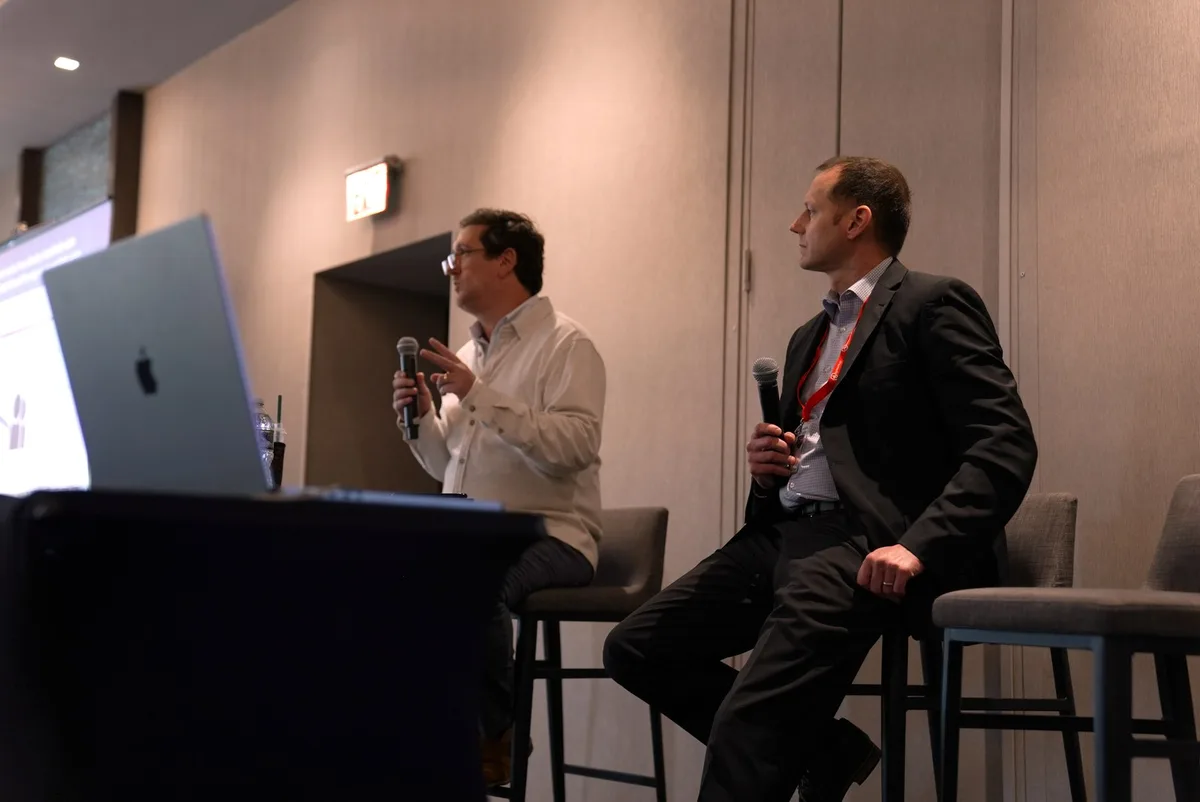
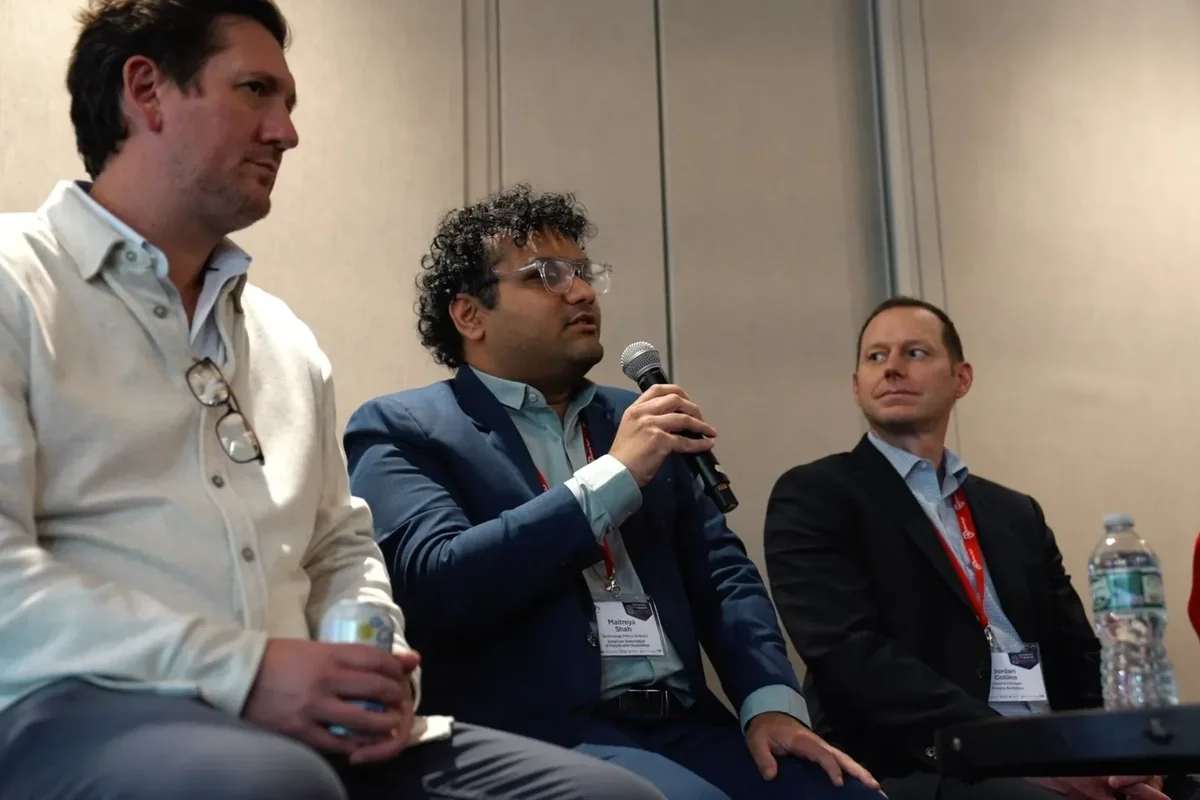
Can AI really do the work of a Data Protection Officer? At the Data Privacy for Health Summit in Boston, three Privacy professionals explored what happens when AI moves from an interesting possibility to a tool used in everyday Privacy operations.
Can AI really do the work of a Data Protection Officer? It’s a question many Privacy professionals are asking themselves. And at the Data Privacy for Health Summit in Boston, we decided to explore it from two different perspectives: what happens when a company actually tries to build an AI-powered DPO platform, and what happens when Privacy teams start relying on AI in their daily work? Through two complementary presentations, Xavier Gobert, Hubert Stoop and Beatrice Botti shared their experiences, the challenges they encountered, and the lessons they learned along the way. One conclusion quickly emerged: AI can transform the way Privacy teams work, but only if we remain clear about what it can, and cannot, do.
The promise of AI, and the risks we cannot ignore
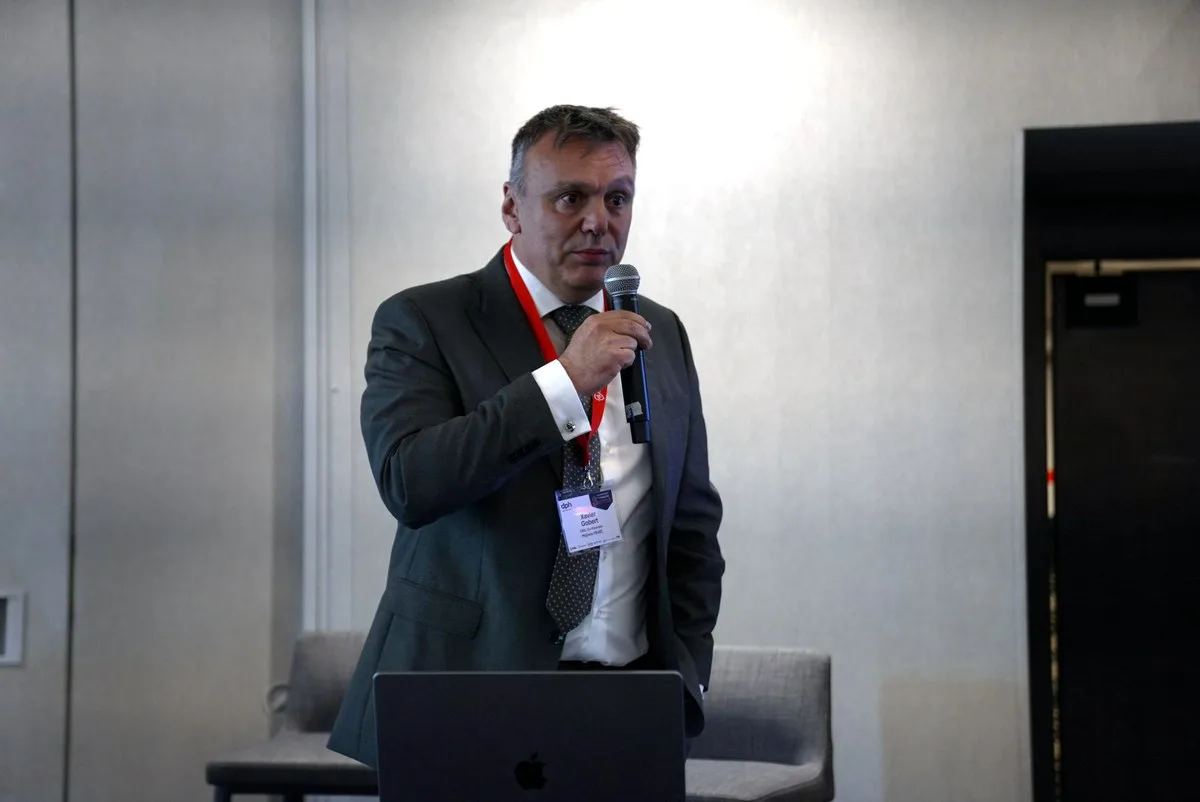
Xavier Gobert, co-founder of MyData-TRUST, opened the discussion with a familiar challenge. For a Data Privacy consultancy working exclusively with Life Sciences organizations across multiple jurisdictions, keeping up with evolving regulations while delivering consistent, high-quality advice is no small task. AI seems like an obvious opportunity: it can process information quickly, support document reviews and potentially reduce time spent on repetitive tasks. But how much can we really trust its answers?
Xavier illustrated the problem with a relatable example. When asking a chatbot to organize room allocations for a family celebration involving 52 guests, the tool confidently invented couples who were not together and even added people who had never been invited. At a family gathering, the consequences might be amusing. In a legal opinion, they could be far more serious. And hallucinations are only part of the problem: generative AI may produce different answers to the same question, reflect biases in training data, or deliver convincing conclusions without clear sources. Add confidentiality concerns and the temptation to accept polished responses without checking them, and the risks become very real. For a DPO, an answer that sounds correct is simply not enough. These concerns led MyData-TRUST to identify four essential conditions for using AI in Privacy operations: confidentiality, reliability, control and accountability.
Putting AI to the test: when good answers are not good enough
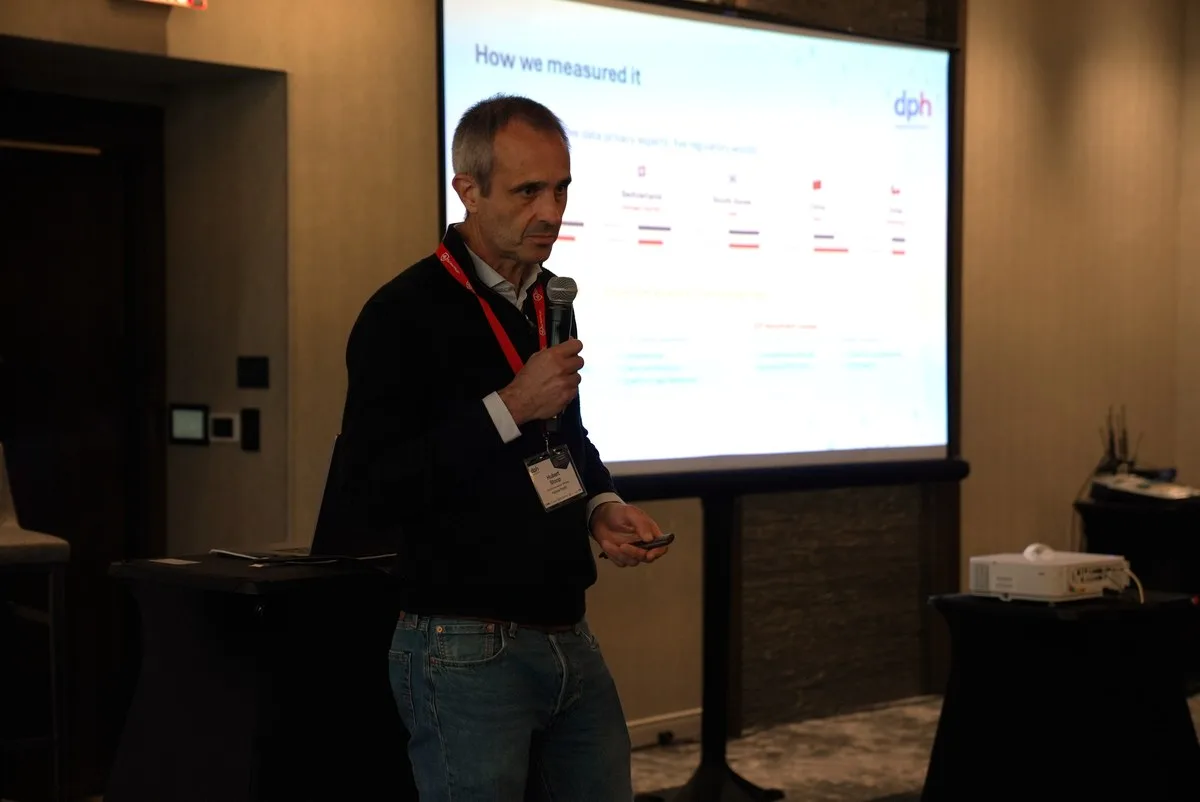
Hubert Stoop, Chief Innovation Officer at MyData-TRUST, took the audience behind the scenes of the company’s first experiments. In February, the team evaluated a leading general-purpose AI assistant equipped with a legal plugin. They tested it across five jurisdictions with different regulatory environments, submitting legal questions and asking it to review informed consent forms against applicable regulations. The objective was not simply to see whether AI could produce convincing answers, but whether those answers were reliable enough for professional use.
The initial results were sobering. On the three most important evaluation criteria, fewer than 25% of answers reached the required professional standard. In informed consent form reviews, the assistant identified only 30% to 50% of regulatory issues. Hubert used a memorable analogy to explain why average performance can be misleading: with your head in the oven and your feet in the fridge, your average temperature might look perfectly fine. Similarly, a tool that performs well most of the time may still be unsuitable when a single missed requirement carries serious consequences.
The team then introduced structured ‘skills’, combining prompts, reference documents, processes and constraints. Performance improved to approximately 90% on the main criteria, making the assistant useful to an expert. But useful did not mean ready for broad deployment. Maintaining knowledge across 61 regulations became difficult, and safeguards around confidential information, traceability and mandatory human validation were still missing. The experiment had revealed both the promise of AI and the limitations of simply adopting an existing solution.
From experiment to platform: building AI around the DPO
Rather than abandoning the idea, MyData-TRUST decided in early May to develop its own AI platform. Four principles guided the project: make expert knowledge the foundation, create a single entry point for client deliverables, require human review before anything reaches a client, and prevent identifiable confidential documents from being sent to external AI models. Three senior developers, supported by coding and quality-check agents, brought the platform into production in 98 days. Around two dozen real business use cases, including informed consent form reviews, are now tested at each release. As Hubert emphasized, a powerful coding assistant does not automatically make someone a senior developer: expertise and rigorous quality control still matter.
Two technical choices stood out. First, documents are pseudonymized in memory before reaching an external model: names, organizations and other confidential details are replaced by tokens using a locally operated entity recognition model. That process requires balance, because masking too much can remove information needed for the review. Second, the platform is model-independent. It can switch between AI models in seconds to address performance, availability or client requirements. Xavier mentioned clients in China who requested a local model instead of a US-based one, a requirement addressed through configuration. The message was clear: AI governance needs to be built into both the technology and the surrounding process.
This approach is part of MyData-TRUST’s broader commitment to innovation through collaboration, combining expert knowledge and practical tools to make Data Privacy management more efficient across Life Sciences.
What does human oversight actually look like?
A demonstration showed how a document compliance review works. The user selects the document, client, project and review tool. After pseudonymization, an expert chooses an appropriate checklist or template, supported by an AI suggestion. The system generates an annotated draft with tracked changes and comments. A first reviewer must accept or reject proposed changes; the document is then locked for final review by a DPO or senior Privacy lawyer. The system records who did what and when, and the document is de-pseudonymized when the client downloads the result. Human oversight is designed as a mandatory step, not an optional recommendation.
Behind the platform, regulatory knowledge is generated with agent support and validated by experts, while another agent monitors regulatory changes for expert assessment. Xavier also highlighted agreements with AI vendors covering data reuse and retention. This is not simply new technology: it also requires new roles, responsibilities and training. Next steps include continuous evaluation, client feedback, random quality checks and links to records of processing activities containing information on more than 3,000 activities documented over nine years. The longer-term ambition is to combine AI efficiency with the expertise needed to cover more than 90 regulations. For clients, this approach could also change how DPO services are delivered, moving toward defined deliverables, greater transparency and more predictable costs. But an AI assistant is not a DPO. Responsibility for the final decision remains with a person.
When AI becomes familiar, do we stop questioning it?
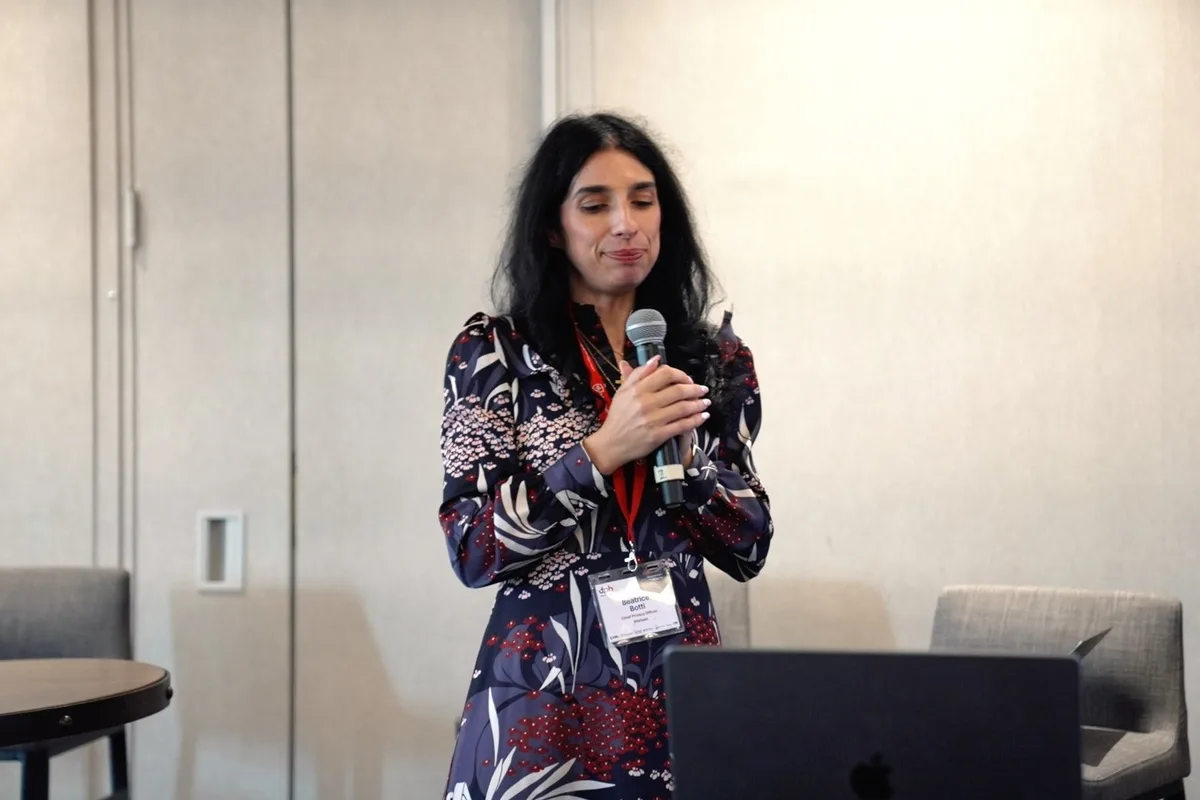
Beatrice Botti, Chief Privacy Officer at Nielsen, brought the discussion back to everyday AI use inside an organization. She recalled an early car navigation device that might once have been considered AI. When it failed during a drive along the coast, the obvious solution of keeping the sea on the right did not immediately come to mind. Her story illustrated a subtle risk: the more familiar a technology becomes, the less we question our dependence on it.
In her experience, some of the hardest AI tools to govern were also the simplest. Engineers generally understand that AI-generated code must be tested for vulnerabilities. But a writing assistant can polish an email while subtly changing what a non-native English speaker intended to say. A meeting summary may emphasize frequently repeated points while missing a short but critical contribution. The risks of AI are not always dramatic. Sometimes they appear in everyday decisions that gradually shape how people work.
AI should support expertise, not replace it
For Beatrice, one rule matters: do not ask AI an open-ended question unless you know enough to evaluate its answer. She pointed to lawyers sanctioned for submitting invented case law and a draft data processing agreement that cited a nonexistent GDPR provision. The danger is that a credible-looking answer can discourage verification.
Where can AI add value? Beatrice described an expert support system that can classify incoming requests by urgency or jurisdiction, identify patterns and draft preliminary contract reviews based on internal playbooks. She recalled analyzing questions from a ticketing system and discovering that an existing Privacy training program was not working. Her team replaced generic training with in-house content. AI had helped reveal a problem rather than make a compliance decision. But it cannot fully understand an organization’s context, exceptions or business realities, and it can be overly agreeable. She also referred to a tribunal decision holding an airline responsible for incorrect information provided by its chatbot.
Before using AI, ask the right questions
Beatrice encouraged teams to assess each use case: what is the task, what data is involved, what could go wrong, who will review the result, do they have the necessary expertise, what evidence is retained, and how reversible is the impact? A routine communication draft does not require the same scrutiny as a decision affecting individuals’ rights. The point is not to impose maximum controls everywhere, but to make oversight proportionate to risk and ensure that reviewers can exercise independent judgment.
The augmented DPO is still a human DPO
The two presentations approached AI from different angles but reached closely aligned conclusions. Xavier and Hubert showed what it takes to build an AI-enabled Privacy process with confidentiality, traceability and mandatory expert review at its core. Beatrice reminded us that even well-designed tools depend on people who understand their limits and challenge their outputs. AI can help Privacy teams work across more jurisdictions, identify issues consistently and reduce repetitive tasks. But it cannot replace professional judgment. The role of the DPO is not disappearing; it is evolving. The augmented DPO is not someone who delegates responsibility to AI, but someone who uses AI to exercise that responsibility more effectively.
The conversation continues at the next Data Privacy for Health Summit in Brussels on January 26, 2027. Join us to explore the regulatory, operational and technological challenges shaping the future of Health Data. Explore the agenda and register. The Summit will then head to San Diego for its next US edition in September 2027.
Read also AI Governance: Start with the Decision, Not the Tool and AI in Healthcare: From Liability to Innovation.
FAQ
Can AI replace a Data Protection Officer (DPO)?
No. AI can support DPO tasks, but professional judgment and final accountability must remain with humans.
How can AI improve the work of Privacy teams?
By automating repetitive tasks, supporting document reviews, and helping identify compliance issues.
What are the main risks of using AI in DPO activities?
Hallucinations, unreliable outputs, confidentiality breaches, and excessive reliance on AI-generated answers.
Related Posts
[ November 5, 2026 ]
Real, Synthetic and In-Between: Unlocking Health Data's Potential
[ November 12, 2026 ]
AI Governance and Privacy: Your Questions Answered