

[November 5, 2026]
Real, Synthetic and In-Between: Unlocking Health Data's Potential
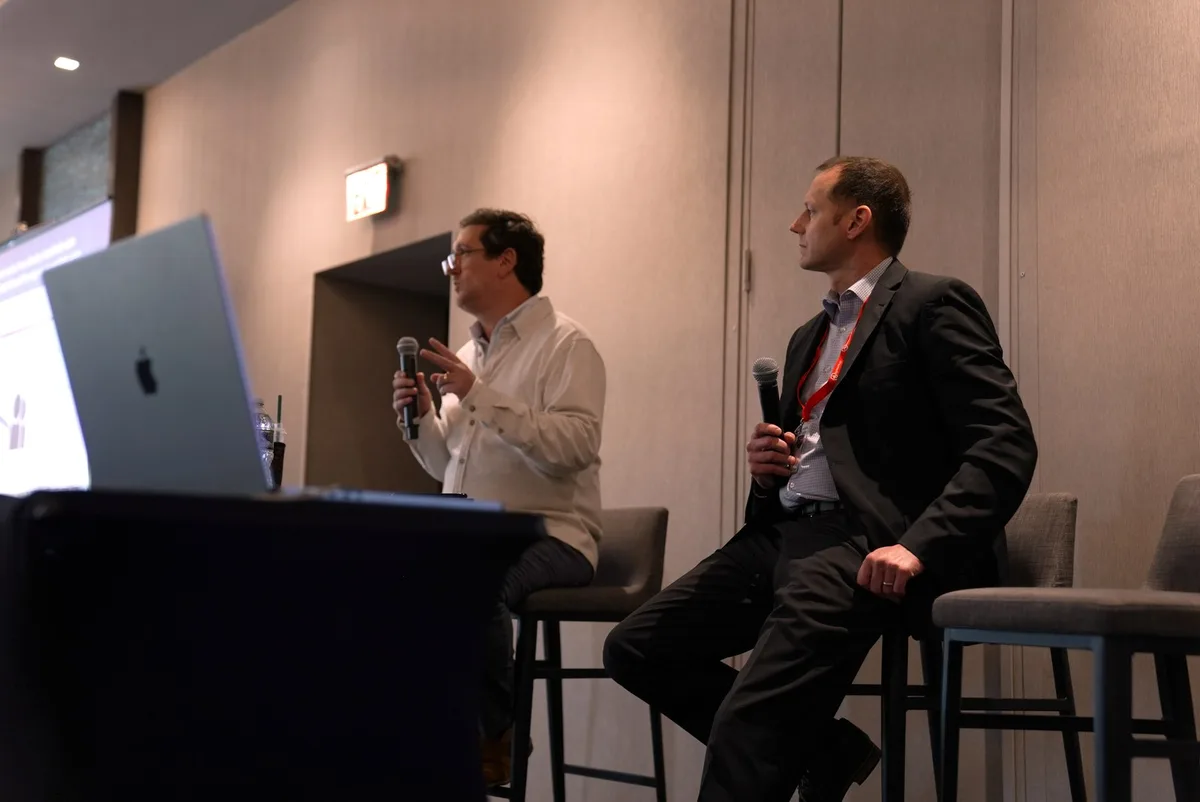
Session recap, Data Privacy for Health Summit, Boston, 1 October 2026
Speakers: Jordan Collins, General Manager, Privacy Analytics; Nicholas Accomando, Global Head, AI and Data Privacy Legal, Novartis.
What if we could create useful Health Data without exposing the patients behind it? Synthetic data is often presented as the answer: artificial records that preserve meaningful patterns while leaving real identities behind. At the Data Privacy for Health Summit in Boston, Jordan Collins of Privacy Analytics and Nicholas Accomando of Novartis unpacked why that promise is both exciting and more complicated than it sounds. Their duo keynote moved between statistics, legal definitions and practical research decisions, returning repeatedly to one deceptively simple question: what exactly are we trying to protect, and for what purpose?
The identifiability spectrum
Nicholas Accomando began by acknowledging how much technology has blurred the language around synthetic and anonymized data. Jordan Collins then invited the audience to imagine a spectrum. At one end sit identifiable patient records, complete with names and other direct identifiers. Remove those details and the records become pseudonymized, but they remain personal data. As more information is removed and re-identification risk is assessed, a dataset may reach a threshold at which it can be considered anonymized. The distinction is not cosmetic: it determines which protections and obligations continue to apply.
Move further along the spectrum and the picture changes again. Synthetic data generated from real patient information aims to reproduce patterns without reproducing the patients themselves. At the far end, simulated data can be built entirely from rules, scientific knowledge or expert assumptions, without any underlying patient records. Jordan argued that these approaches should not be treated as opposing categories. Synthetic generation can be another method for reducing the information that links a record to a real person, provided its privacy risk is properly assessed.
A methodology versus a determination
Accomando, who described himself as a ‘definitions guy,’ compared common descriptions of synthetic data. Some emphasize artificial information that mimics real-world statistical patterns; others suggest that synthetic data is generated rather than collected. He challenged the idea that generation necessarily means independence from real data. Modern models are often trained on precisely the real-world records we are trying to protect. That makes the definition only the beginning of the conversation.
His central distinction was memorable: synthetic data is a methodology, while anonymization is a determination. The regulatory lens matters too. Nick contrasted the European Data Protection Board’s risk-based approach, under which generated data may still be personal if people can be identified, singled out or linked, with a generally different working assumption in US practice. Rather than relying on the word ‘synthetic,’ organizations need to demonstrate what their dataset does and does not reveal.
Nick also raised the question of what the model itself contains. Two questions follow: whether the model itself is synthetic, and whether the data it generates is. Researchers have shown that early versions of ChatGPT could be prompted to reproduce data memorized during training. Later models with reinforcement learning from human feedback refused direct requests, but carefully crafted prompts could push them to answer as the underlying base model, before that feedback layer. If a model can leak training data on request, what might it leak when generating a synthetic dataset?
Jordan added that these reconstruction attacks predate LLMs. They are classic statistical disclosure control problems, the ones statisticians, including teams like those at Privacy Analytics, have long measured to estimate how likely an attack is and how to protect against it. What has changed is how easy, fast and cheap the attacks have become, and how much data can be brought together to launch them.
The better the synthetic data, the higher the risk
In practice, Jordan said, organizations often use hybrid approaches: generalizing ages or geography, removing rare events, and synthesizing the information that is hard to collect or risky to track. That makes the question “what exactly are we protecting?” harder to answer.
Nick captured the trade-off in a line that stayed with the room: the better synthetic data becomes, the greater the concern that it may no longer be sufficiently synthetic. Imagine a spreadsheet in which each row represents a patient. In de-identified data, the patient is real, and the relationships between diagnosis, comorbidities and treatment remain intact. In properly synthetic data, population-level statistics may survive, but each row represents an invented patient. That can be useful for testing software or exploring population patterns, while making the data unsuitable for some questions that depend on authentic patient-level relationships.
Purpose first, then method, then privacy
Both contributors urged the audience to reverse the usual order of decisions. Are we testing software, studying a rare disease or building evidence for a scientific claim? Each purpose requires a different kind of data. Jordan proposed a practical sequence: define the purpose, select a method capable of answering the question, then assess whether its privacy protections are appropriate. A sophisticated synthetic dataset is not a success if it cannot support the research it was created for.
Nick added an essential legal question. Anonymization itself involves processing data, and using patient records to train a synthetic-data model may involve a different purpose from the one for which those records were originally collected. Before celebrating the output, organizations must establish whether they had an appropriate legal basis to process the input.
In practice, privacy risk assessments can help organizations document those decisions, especially when the same data may be reused for research, AI development and cross-border collaboration.
Nick also clarified responsibilities under the EU AI Act, used here as a baseline because it is the most developed framework. Most organizations in the room are deployers of AI, not providers. Providers such as the developers of large language models are responsible for how their models were trained; deployers are responsible for using them appropriately, including when generating synthetic datasets, and their obligations are very different.
A harm specific to synthetic data
Jordan introduced a less familiar concern. Re-identification of anonymized data can expose sensitive facts about a real person. But what if a synthetic record is entirely fictional and someone mistakenly believes it describes an identifiable individual with a serious illness? The record may be false, yet the reputational damage could still be real. It was an invitation to think about harms beyond conventional re-identification risk.
Nick pointed to a second, very practical danger. Large research platforms contain datasets governed by different permissions and built for different purposes. If a researcher mistakes synthetic records for de-identified real-world evidence, the analysis may rest on relationships that never existed. Clear metadata and labeling are therefore part of responsible data governance, not administrative housekeeping. Jordan added that an unmarked synthetic dataset can even send an audit team searching for protections and origins that do not exist.
What the room asked
A participant asked which type of synthetic data is harder to reverse engineer, and how the FDA views the risk. Jordan answered that knowledge-based synthetic data, generated from expert knowledge or physics models, carries far less risk than data-based synthetic data built from real patient records. Statisticians were already simulating realistic datasets from expert input sixty or seventy years ago, for software testing and root cause analysis; only the name has changed. Nick agreed but noted that synthetic control arms in rare diseases must be built from real data: with so few patients, modeling is sometimes the only way to run informed trials. On the FDA, Nick discussed the agency’s historical reluctance to accept de-identified real-world evidence in submissions. Recent FDA guidance for certain medical device submissions signals a shift: identifiable individual patient data is no longer always required, although sponsors must still demonstrate the provenance, integrity and fitness for purpose of the evidence. Nick also highlighted the different considerations for drugs and biologics, where real-world data collected during routine care may lack some of the controls associated with clinical trials and must be evaluated accordingly. Progress with the FDA on synthetic and real-world data is real but slow, Nick said, and both remain useful in specific situations.
Jordan brought the discussion back to three practical tests for digital twins and any evidentiary claim: where the data came from, how privacy was protected along the way, and whether the data is valid for the scientific claim being made. These questions, he emphasized, cannot be answered by the label “synthetic” alone. Accountability for the final judgment must stay with a human.
A participant working on rare disease trials asked how to honor a European patient’s request to be forgotten when identity vaults allow data to be traced back to the source. Nick explained that in large trials, deleting one patient’s data rarely matters, while in rare diseases an organization can often make a strong case that deletion would materially affect the trial. With truly synthetic data generated by a statistical model, there is no going back. With coded trial data, where the organization holds the keys, deletion is possible if the exception does not apply. Jordan observed that rare disease patients often want their data reused and linked, because research is their best hope of better care, and asked whether consent forms could anticipate this. Nick noted that broad consent is interpreted differently across EU member states, and that organizations often have to reconsent patients for future uses.
Finally, a researcher described a synthetic data tool combining generative adversarial networks, transformers and differential privacy that, in their analysis, could not be reversed. Jordan welcomed the work and drew the distinction the session had built up to: truly synthetic data, with privacy protections built in, which is hard to achieve, versus data that is only purportedly synthetic. The discussion then had to stop, well over time; the remaining questions moved to the afternoon panel, where both speakers joined the other experts.
The questions that remain
The session ended without a universal answer, and that was perhaps its most useful conclusion. Nick’s distinction between synthetic data as a methodology and anonymization as a determination offers one guiding principle. Jordan’s equally practical takeaway is to start with the intended use, choose data that can answer the question, and test its provenance, privacy protections and scientific validity. Synthetic data can open valuable opportunities for research, software testing and some rare disease applications, but the label alone guarantees nothing. For organizations operating across the Atlantic, differing regulatory expectations make that discipline especially important. The real opportunity is not to choose between “real” and “synthetic” as competing camps, but to use each responsibly for the questions it can genuinely answer.
Privacy-enhancing technologies and the EHDS will be discussed from a European perspective at the Data Privacy for Health Summit in Brussels on 26 January 2027. See the programme and register. The Summit will then head to San Diego for its next US edition in September 2027.
Read also AI Governance and Privacy: Practical Questions from the Audience and Privacy-Enhancing Technologies: Enabling Data Innovation Without Compromise.
FAQ
What is the difference between synthetic data and anonymized data?
Synthetic data is created through a generation process, while anonymization is a determination that data no longer identifies individuals under the applicable legal framework.
Does synthetic data eliminate Data Privacy risks?
No. Synthetic data generated from real patient records can still present re-identification or reconstruction risks.
How should organizations decide whether to use synthetic data?
They should define their research purpose, choose an appropriate method, and assess the data's privacy protections, provenance, and scientific validity.
Related Posts
[ November 3, 2026 ]
AI Governance: Start with the Decision, Not the Tool
[ November 10, 2026 ]
The Augmented DPO: Where AI Stops, Human Judgment Begins